
The Maldives Residential Model: Securing Scarcity
Indian Ocean | Residency
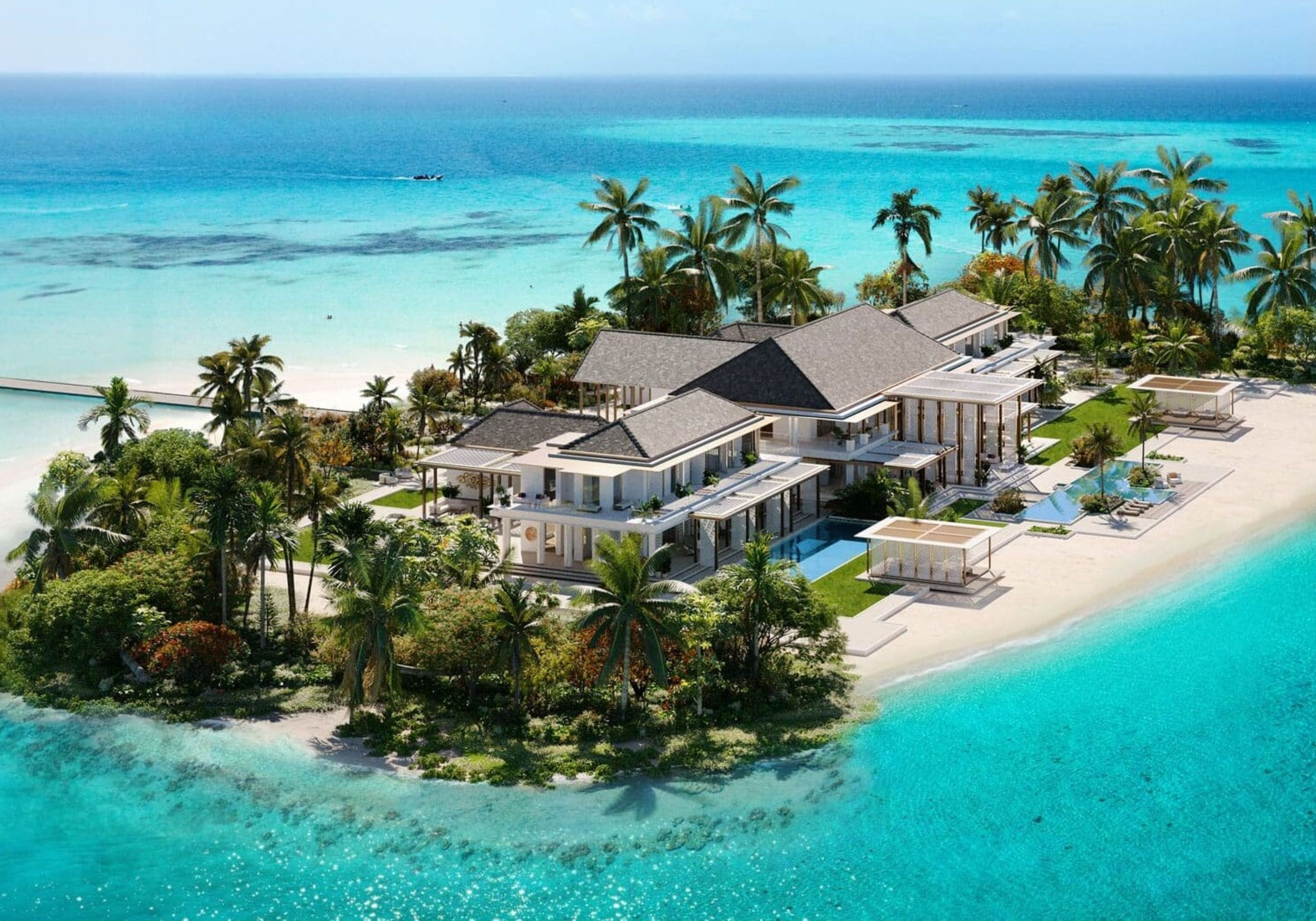
The Maldives residential model: Why it's finally emerging and why it matters
The Maldives has been the Indian Ocean's most successful luxury hospitality market for three decades. It has also been the region's most frustrating property market for the internationally mobile buyer who wanted to own rather than rent access to what the islands offer.
That is changing. Not incrementally. Structurally.
The Maldivian government has introduced freehold ownership rights for foreign nationals in specific integrated resort developments. Ritz-Carlton Reserve, Soneva, Waldorf Astoria and Fairmont are all developing branded residence components within their resort properties. And the buyers who have been waiting for genuine ownership in the Maldives are beginning to move capital in ways that suggest the market understands what is actually being offered.
Why the Maldives resisted residential development.
The Maldivian government's historical position on foreign ownership of land was absolute: no freehold, no long-term leases, no ownership structures that would enable foreign nationals to acquire permanent property rights in the islands.
This was not economic protectionism. This was existential concern about a nation whose entire territory consists of low-lying coral atolls whose long-term habitability depends on environmental management that foreign-controlled development might compromise.
The Maldives is 1,192 islands across 26 atolls. Only 200 islands are inhabited. The highest natural elevation is 2.4 metres above sea level. Climate change is not a theoretical risk — it is an immediate threat to the nation's physical existence. The government's resistance to foreign ownership was grounded in the reasonable belief that permanent foreign property rights would create development pressures incompatible with the ecological constraints that make the islands habitable.
The hospitality model that emerged — long-term resort leases granted to international hotel operators, with no individual ownership and no permanent residence rights — was designed to extract maximum economic value from tourism while maintaining government control over development density and environmental impact.
That model succeeded economically. The Maldives became the world's premier luxury beach destination. But it created no property ownership pathway for the internationally mobile buyer who wanted to own in the one place on earth whose natural environment cannot be matched.
What changed and why it matters.
The Maldivian government's shift toward permitting freehold ownership in integrated resort developments represents a calibrated evolution rather than a wholesale abandonment of environmental protectionism.
The new framework is specific. Freehold ownership is permitted only within resort developments that meet minimum investment thresholds — typically USD 50 million for the overall project. The developments must include significant hospitality components managed by internationally recognised brands. They must meet environmental impact standards enforced by the Ministry of Environment. And critically, they must be located on islands already designated for resort development rather than on inhabited islands or ecologically sensitive atolls.
This is not Dubai-style open ownership. This is controlled, selective freehold within developments that the government has determined can support residential components without compromising environmental management or national sovereignty.
The brands that have moved first are significant. Ritz-Carlton Reserve is developing branded residences at Raa Atoll with villas priced from USD 5 million. Soneva — the brand that pioneered barefoot luxury in the Maldives — is introducing ownership options at Soneva Jani with multi-bedroom villas priced from USD 8 million. Waldorf Astoria has announced residential components at Ithaafushi. Fairmont is developing branded villas at several locations.
These are not speculative developments by unknown developers testing market appetite. These are the brands that define ultra-luxury hospitality in the Maldives committing capital to residential products because they have analysed demand and concluded that the ownership model is viable at price points that reflect the Maldives' unique positioning.
Who the buyer actually is.
The buyer who purchases a branded residence in the Maldives at USD 5 million to USD 15 million is not the buyer who purchases an IRS villa in Mauritius at USD 800,000 for residence rights and tax structure.
The Maldives residential buyer is someone for whom conventional luxury has become universally accessible and environmental uniqueness is the only luxury that money can still purchase reliably. They have properties in London, Dubai, Singapore or New York. They have access to private aviation and hotel residences globally. What they cannot manufacture is the Maldives' combination of water clarity, marine biodiversity and physical isolation.
This buyer values ownership not for capital appreciation — the Maldives property market has no liquidity and no price discovery mechanism that would support conventional investment analysis — but for guaranteed access to an environment that exists nowhere else on earth.
The villa is not a second home. It is a permanent reservation in the world's most extraordinary natural environment. The buyer who owns a Soneva residence is not competing with other buyers on who can afford the most expensive property. They are securing access that money alone cannot guarantee in a market where availability is constrained by geography, regulation and carrying capacity.
The family office buyers who have moved into this market understand this distinction. They are not evaluating the Maldives residence against comparable investments in other beach markets. They are evaluating it against other strategies for securing long-term access to genuinely unique environments — private islands, conservation reserve land, properties in jurisdictions with strict development controls. The Maldives residence is one option in a category where alternatives are extremely limited.

The economic model and what it actually delivers.
The branded residence model in the Maldives does not deliver rental yield in any conventional sense. The villas are owner-occupied during the high season when rental rates would be highest. They generate minimal rental income during the monsoon season when occupancy across the entire Maldives market drops substantially. The net result is that rental returns are negligible relative to the capital invested.
The buyers who approach this as an investment expecting financial returns will be disappointed. This is not an investment in the conventional sense. It is a purchase of permanent access packaged as property ownership.
What the residence does deliver is management infrastructure that ensures the property functions at resort standards whether the owner is present or absent. Soneva, Ritz-Carlton and Waldorf Astoria are not property developers selling units and walking away. They are hospitality operators managing branded residences to the same standards as their hotel rooms. The villa is maintained, staffed and operated as part of the resort's broader management ecosystem.
For the buyer who values not having to think about property management this is essential. A Maldives villa without professional management becomes a maintenance liability in a harsh marine environment. The branded residence model eliminates that complexity by embedding management into the ownership structure.
The capital appreciation pathway is uncertain. There is no established resale market for Maldives branded residences because the category is too new and the buyer pool is too narrow. Liquidity is effectively zero. Exit requires finding another buyer who values the property exactly as the seller valued it — rare in a market with no price discovery mechanism.
The buyers who understand this are not planning to sell. They are purchasing an asset they intend to hold indefinitely and potentially transfer to the next generation as part of a broader family wealth strategy. For those buyers the lack of liquidity is not a barrier. It is a feature that ensures the property's exclusivity remains intact.
What Malik thinks.
The emergence of freehold residential ownership in the Maldives is the most significant development in Indian Ocean luxury property since the introduction of Mauritius' IRS framework. It creates access to an environment that has been effectively closed to ownership for decades.
The buyers who will benefit from this are not conventional property investors. They are ultra-high-net-worth individuals and family offices for whom the Maldives represents something that cannot be purchased elsewhere — a combination of natural beauty, ecological uniqueness and physical isolation that exists in perhaps five or ten locations globally.
The price points — USD 5 million to USD 15 million for branded residences — reflect scarcity value rather than construction cost. The buyers who balk at those prices are not the intended market. The buyers who understand that scarcity is the only luxury that money cannot manufacture will find the Maldives residential model exactly what they have been waiting for.
This is not for everyone. It is not designed to be. It is designed for the buyer who wants to own in the world's most extraordinary marine environment and for whom cost is secondary to access.
The Maldives has opened a door that has been closed for thirty years. The buyers who understand what that means are already moving. The buyers who do not understand should look elsewhere — the Indian Ocean offers dozens of excellent property opportunities for buyers whose primary objectives are different. But for the buyer who wants the Maldives specifically, the branded residence model is the only pathway to ownership that will exist.