
The IRS Template: How Anahita Changed Mauritius
Indian Ocean

Ananita
The IRS residence that changed Mauritius property
There is a specific property development that marks the moment when Mauritius stopped being a beach holiday destination with incidental real estate and became a genuine investment jurisdiction with institutional credibility.
That property is Anahita — the first large-scale Integrated Resort Scheme development to deliver what the IRS legislation promised in theory and what the international buyer required in practice. Freehold ownership for foreign nationals. Permanent residence rights. Tax efficiency structured into the legal framework rather than layered on top of it. And a built environment that could compete with the Gulf and the Caribbean on quality rather than apologise for being in the Indian Ocean.
Anahita opened in 2008. The Mauritius property market has not been the same since.
What the IRS framework actually created.
The Integrated Resort Scheme was introduced by the Mauritian government in 2002 as a deliberate strategy to create a high-value property investment category that would attract international capital and internationally mobile residents without compromising the broader housing market or creating the kind of speculative excess that has destabilised other small island economies.
The framework is specific. An IRS development must include a five-star hotel component. It must meet minimum environmental and architectural standards enforced by the Economic Development Board. It must reserve a percentage of units for Mauritian nationals at government-controlled pricing. And most importantly for the international buyer it grants automatic permanent residence rights to purchasers and their immediate families.
This is not citizenship. This is not passport access. This is permanent residence — the legal right to live in Mauritius indefinitely, to enter and exit without visa requirements, and to access the tax and regulatory framework that has made Mauritius the Indian Ocean's most sophisticated offshore jurisdiction.
The minimum purchase threshold is USD 375,000. At that entry point the buyer acquires freehold ownership of a villa or apartment in a resort-integrated development, plus permanent residence rights for themselves, spouse and dependent children. For the South African buyer evaluating offshore diversification or the Indian buyer navigating capital controls or the European buyer seeking tax efficiency this is an extraordinarily efficient structure.
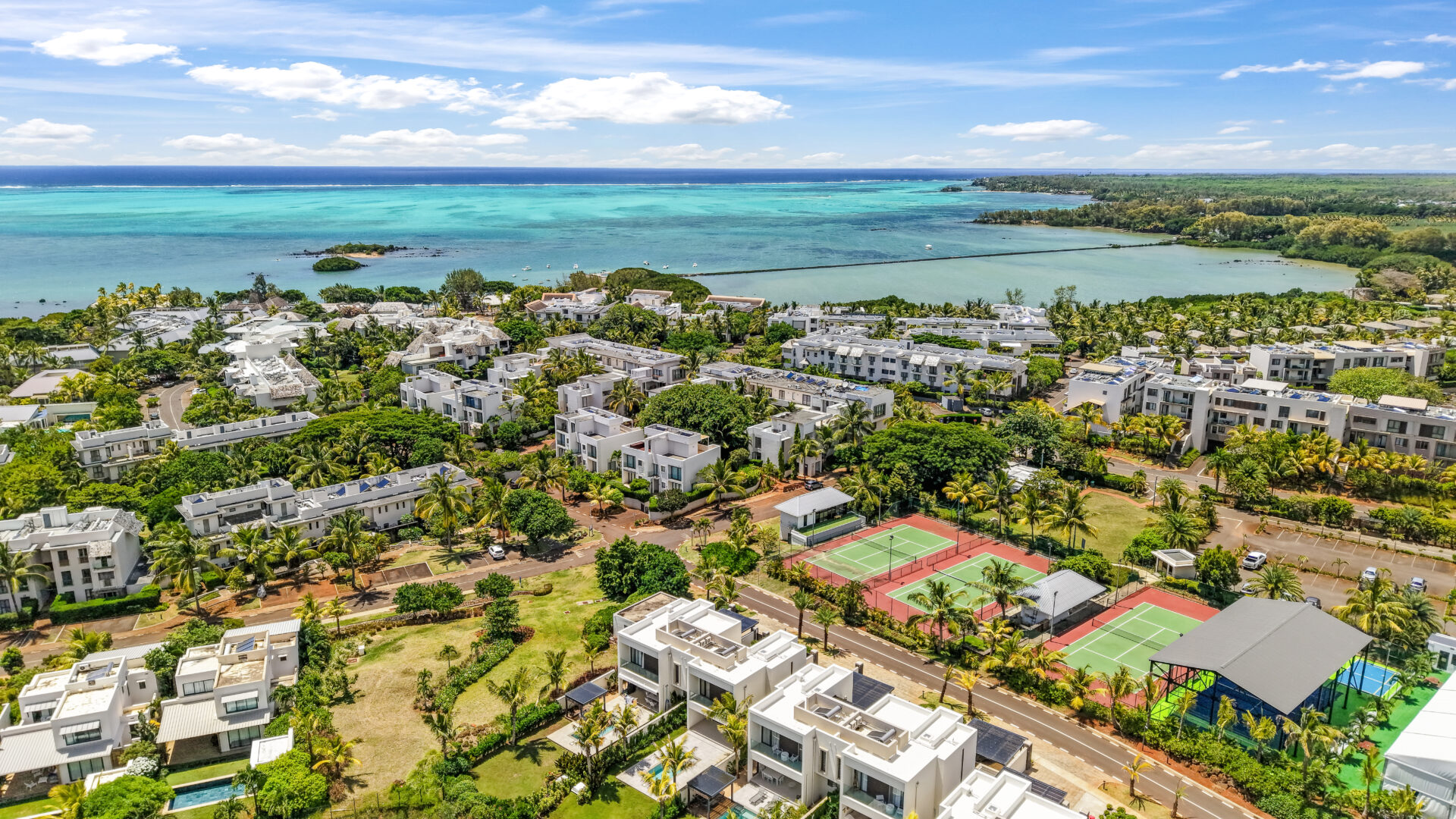
Anahita was the first development to prove the model at scale. Four Ernie Els-designed golf courses. A Four Seasons hotel as the anchor hospitality component. Villas ranging from two to five bedrooms priced between USD 600,000 and USD 3 million at launch. And most critically a management infrastructure that could deliver the service standards and operational consistency that international buyers require when purchasing property they will not occupy full-time.
Azuri
Who it is actually for versus who it is marketed to.
The marketing materials for Anahita and the subsequent IRS developments that followed its model present the properties as luxury lifestyle investments. Golf course frontage. Beach access. Resort amenities. The villa as a second home in paradise.
That is the marketing. The reality is more complex and more interesting.
The buyer who purchases an IRS property for lifestyle reasons — who genuinely intends to spend significant time in Mauritius, who values the golf course and the beach and the resort environment as primary benefits — represents a minority of the actual IRS buyer base. These buyers exist and they are well served by the product. But they are not the core market.
The core market is the internationally mobile buyer who needs a legal structure that provides residence rights, tax efficiency and asset diversification in a jurisdiction with strong rule of law and institutional stability. The villa is the vehicle for accessing that structure. The lifestyle amenities are secondary.
For the South African buyer this means a hedge against political and currency risk, access to a tax jurisdiction that does not impose capital gains tax on offshore assets, and a residence base that facilitates global mobility in ways that a South African passport increasingly does not. The villa in Anahita is not primarily a holiday home. It is a legal and financial infrastructure that happens to take the form of a residence.
For the Indian buyer navigating capital controls and inheritance tax complexity the Mauritius IRS property serves a similar function. The Mauritius-India Double Taxation Avoidance Agreement creates specific advantages for structuring investments through Mauritian entities. The permanent residence rights enable physical mobility that Indian tax residency would otherwise constrain. The freehold property is the anchor that makes the entire structure accessible.
For the European buyer — particularly French, British and Italian nationals seeking tax efficiency without the compliance complexity of traditional offshore structures — Mauritius offers a regulated, transparent jurisdiction with residence rights tied to a physical asset rather than a complex corporate structure. The IRS property is cleaner, simpler and more defensible than the alternatives.
The buyers who purchase IRS properties for these reasons care about the villa's quality and the resort's amenities, but those factors are not the primary driver. The primary driver is legal structure, tax efficiency and residence rights. The resort environment is the packaging that makes the structure politically and socially acceptable.
What Anahita specifically delivered.
Anahita succeeded where earlier Mauritius property developments had failed because it delivered institutional-grade management in a market that had historically offered boutique-scale service.
The Four Seasons hotel component was critical. Not because buyers needed access to Four Seasons service — though that was valuable — but because Four Seasons' presence signalled that the development would operate to international standards, would maintain property values through professional management, and would not deteriorate into the kind of under-maintained resort development that had defined earlier Mauritius property offerings.
The rental management programme that Anahita established became the template for subsequent IRS developments. Owners who chose to let their villas could place them in the resort rental pool managed by the Four Seasons. The returns were modest — typically 3 to 5 percent gross yield — but the programme provided liquidity and offset carrying costs for owners who occupied their properties infrequently.
The property management infrastructure handled maintenance, security, and the administrative complexity of owning property in a jurisdiction where the owner might be physically absent for most of the year. This was not a luxury service. This was a necessity. The internationally mobile buyer cannot manage property from a distance without professional infrastructure. Anahita provided that infrastructure as a core offering rather than an optional add-on.
The capital appreciation has been real but modest. Villas that sold for USD 800,000 in 2008 are now worth approximately USD 1.2 to 1.4 million depending on size and position. That is a compound annual growth rate of roughly 3 to 4 percent — below what comparable Gulf property delivered during the same period but above what the Caribbean or most European beach markets achieved.
The buyers who purchased Anahita villas in 2008 did not make extraordinary capital gains. But they acquired permanent residence rights in a stable jurisdiction, obtained tax-efficient structures for managing offshore wealth, and secured a physical asset that retained value through a global financial crisis and a pandemic. For the buyer whose primary objective was legal structure rather than capital appreciation that outcome is exactly what the investment was designed to deliver.

Tamarina
How the IRS framework evolved.
Anahita's success catalysed a wave of IRS developments across Mauritius. Heritage Villas Valriche, Azuri Ocean and Golf Village, Les Villas Valriche, Tamarina Golf and Beach Estate — each attempted to replicate Anahita's model with variations in price point, location and resort positioning.
Not all succeeded. The developments that failed shared common characteristics: insufficient capitalisation leading to construction delays, weak property management infrastructure that allowed deterioration, and pricing that overestimated the market's willingness to pay premium rates for locations outside the established resort zones.
The developments that succeeded followed Anahita's template: strong anchor hospitality brand, professional property management, realistic pricing relative to location and quality, and transparent communication about what the permanent residence rights actually provided versus what they did not.
The IRS framework itself has matured. The government introduced the RES (Real Estate Scheme) and PDS (Property Development Scheme) as alternative structures with lower minimum thresholds and different residence right provisions. These schemes have broadened the market but have also created complexity for buyers who do not fully understand the differences between IRS, RES and PDS properties.
The critical distinction: only IRS properties grant automatic permanent residence rights at purchase. RES and PDS properties may qualify for residence permits but the process is discretionary and the rights are less comprehensive. For the buyer whose primary objective is residence rights this distinction is fundamental.
What Malik thinks.
The IRS framework changed Mauritius property from a niche market for retirees seeking beach access into a serious investment category for internationally mobile buyers seeking legal structure, tax efficiency and residence rights in a stable jurisdiction.
Anahita proved the model. The buyers who understood what they were purchasing — legal infrastructure packaged as a luxury villa — made decisions that have delivered exactly what the structure promised. The buyers who approached it as a pure lifestyle investment or who expected Gulf-level capital appreciation were frequently disappointed.
The distinction matters. An IRS property in Mauritius is not a beach house. It is a legal and financial structure that happens to take the form of a beach house. The buyers who understand that distinction will find the IRS framework one of the most efficient structures available globally for accessing permanent residence rights tied to a physical asset in a well-regulated jurisdiction.
The buyers who do not understand that distinction should look elsewhere. The Seychelles offers better natural environment. The Maldives offers better resort experience. The Gulf offers better capital appreciation. Mauritius offers better legal structure — and for the buyer who values legal structure above all else, that makes the IRS property category genuinely compelling.
Anahita is no longer the only option. But it remains the template against which all subsequent IRS developments are measured. The buyers who understand why it succeeded will make better decisions about which of the current IRS offerings actually delivers what the marketing promises.